
LIFE & WELL-BEING
Life Coaching Guide:
What It Is, How It Works,
& How to Choose the Right One
If you’re the person everyone relies on, and you’re quietly exhausted by it, this guide will help you understand what a life coach actually does, what it costs, and how to find one who gets it.
Everything you need to know before starting
your life coaching journey
Most of the people who reach out to me aren’t lacking willpower or intelligence. They’re capable, driven, and doing everything “right,” and still stuck in the same exhausting loop. That’s rarely a discipline problem. It’s usually a sign the thinking that created the pattern isn’t the thinking that’s going to solve it.
This guide walks through what life coaching actually involves, who it genuinely helps, and how to know if it’s the right next step for you.
“You cannot solve a problem with the same thinking that created it.”
What Is a Life Coach, Exactly?
A life coach is a trained professional who works with you on the patterns currently shaping your day-to-day life, not your childhood, not a diagnosis, but the specific habits of thought and behavior that are keeping you stressed, stretched thin, or stuck. The International Coaching Federation defines coaching as a partnership that sparks reflection and creativity in a way that helps you unlock your own thinking, rather than someone handing you their opinion on what to do.
That last part is what surprises most new clients. A coach isn’t there to tell you to quit your job, leave the relationship, or start meditating for twenty minutes a day. A good coach asks the question you’ve been avoiding, then stays quiet long enough for you to actually answer it. The insight has to be yours, because you’re the one who has to live with it and act on it.
This is also what separates coaching from advice, whether from a well-meaning friend, a mentor, or even a manager. Advice comes from someone else’s experience projected onto your situation. Coaching starts from your own values, your own constraints, and your own definition of what “better” would actually look like, which is usually far more specific than “less stressed.”

Why Perfectionists & People-Pleasers Need a Different Approach
Perfectionism usually isn’t about high standards. It’s about safety.
Researcher and author Brené Brown draws a useful distinction here: healthy striving is self-focused (“how can I improve?”), while perfectionism is other-focused (“what will they think?”). If you were praised growing up mainly for achievement, or if mistakes were met with disappointment rather than curiosity, your brain likely learned a shortcut: flawless work equals safety from criticism. Decades later, that shortcut is still running, even though the stakes of a slightly imperfect email are nowhere near what they once were.
People-pleasing often isn’t a personality trait. It’s a learned response to conflict.
Therapists sometimes describe this as a “fawn” response, alongside the more familiar fight, flight, and freeze. Instead of confronting a threat or fleeing it, you appease it: you agree, you accommodate, you make yourself easy to be around, because somewhere along the way that felt safer than risking someone’s disapproval. It’s not weakness. It’s a strategy that worked well enough, for long enough, that it became automatic.
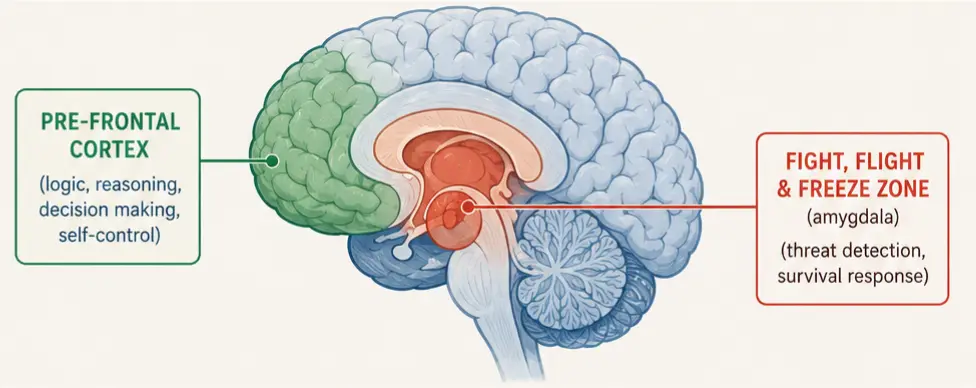
This is exactly why “just set a boundary” or “just let it go” rarely works for this audience. The advice targets the behavior, but the behavior isn’t the problem. The belief underneath it is: if I’m not needed, I’m not valuable, or if this isn’t perfect, I’ll be judged. Coaching works because it goes after the belief directly, with someone trained to notice it even when you can’t see it in yourself.
A Client Example
A client once came to me sure her problem was her planning abilities. She was a senior project manager, new mom, and was convinced that if she was just better organized, the constant low-grade panic would ease up.
A few sessions in, a different pattern emerged. She’d agreed to lead a project two colleagues had turned down, on top of an already full plate, because she “didn’t want to seem like she couldn’t handle it.” When I asked what she was afraid would happen if she’d said no, she went quiet, then said, “They’d realize they don’t actually need me as much as they think.”
That sentence was the real work. Not the calendar. We spent the following sessions unpacking where that belief came from and practicing, in low-stakes moments first, what it felt like to let people be mildly inconvenienced by her boundaries instead of catastrophically disappointed. Her workload didn’t change overnight. Her relationship to her self-worth and how to say no in her own way did.
If any part of that felt familiar, this is worth a conversation.
How Does Life Coaching Actually Work?
Coaching isn’t a single conversation, and it isn’t an open-ended chat either. Most engagements follow a fairly consistent arc over a few months. Here’s what that typically looks like in practice.
1. Getting Specific About What’s Actually Wrong
Early sessions are less about solving anything and more about getting precise. “I’m stressed” isn’t specific enough to act on. “I feel a knot in my stomach every Sunday night because I’ve said yes to something I resent by Wednesday” is. Most people arrive with a vague, global sense of overwhelm; the first real progress is narrowing that down to a pattern you can actually work with.
2. Learning to Catch the Pattern in the Moment
Once the pattern is named, the next skill is noticing it as it’s happening, not three days later while venting to a friend. A simple tool I often use here is a short trigger log: a few words, jotted down right after a moment of stress, noting what happened and what you felt compelled to do about it. Within a couple of weeks, most clients start recognizing the pattern in real time, which is the first moment they actually have a choice.
3. Practicing a Different Response, Starting Small
You don’t overhaul a decade-old habit by deciding to be a different person on Monday. We pick one small, specific, low-stakes situation to practice a different response in, saying “let me think about it” instead of an automatic yes, submitting something at 90% instead of 110%. Small and repeatable beats big and unsustainable, because it’s the repetition that eventually makes the new response feel normal instead of effortful.
4. Reviewing What’s Working, With Real Accountability
This is the step people skip when they try to change alone, and it’s usually why the change doesn’t stick. Each session, we look at what you tried, what got in the way, and what to adjust. Having someone else track your progress with you, someone who isn’t emotionally entangled in your decisions the way friends or family are, tends to be the single biggest difference between insight that fades and change that actually holds.
What Does It Cost, and How Do You Choose the Right Coach?
Coaching rates in Switzerland vary widely depending on a coach’s experience, credentials, and format. As a general guide, individual sessions commonly range from roughly CHF 150 to CHF 350, with packages usually working out more cost-effective than paying session by session, since real change tends to unfold over a few months rather than a single hour. Most coaches, myself included, offer a free introductory call so you can get a feel for the process before spending anything.
Because coaching isn’t a regulated profession the way therapy is, anyone can call themselves a coach. This makes a few things worth checking before you commit:
- ICF credentials. The International Coaching Federation is coaching’s leading global body. Its entry-level credential (ACC) requires at least 60 hours of accredited training and 100 hours of supervised coaching experience; the mid-level (PCC) requires 125+ training hours and 500+ coaching hours. It’s not a guarantee of chemistry, but it is a solid baseline for training and accountability.
- A specific methodology, not just “we’ll talk it out.” Ask what framework they use, and why they think it fits what you’re dealing with.
- Relevant specialization. A coach focused on stress patterns and self-sabotage will approach your situation very differently than one focused purely on career strategy or business growth.
- A genuine fit, tested on the call itself. You should leave a free consultation feeling both challenged and safe. If it feels like a sales pitch instead of a real conversation, that’s useful information too.
- Transparency on logistics. Session length, frequency, cancellation policy, and pricing should all be clear before you sign up for anything, not left vague until later.
If you’d like to see exactly how I structure sessions and pricing, let’s have a chat! You can also read about my own training and certification on the about me page.
FAQ
How is life coaching different from therapy?
Therapy generally looks backward, helping you understand and process past experiences, and is appropriate for diagnosed mental health conditions. Coaching looks forward, working with the patterns currently shaping your daily life. If you’re not sure which applies to you, a good coach will tell you honestly if therapy is the better starting point.
How do I know if I actually need a coach, or if I should just push through?
Is the cost really worth it?
Most clients describe it less as an expense and more as the first time they’ve invested directly in themselves rather than in their output. That said, it’s a fair question to weigh against your own priorities and budget, and any honest coach will welcome that conversation.
How long does it typically take to see a difference?
Many clients notice more clarity within the first two or three sessions. The behavioral change that actually sticks, the kind where a new response becomes automatic, usually takes a few months of consistent practice.
5 Questions to Ask Yourself Before Choosing a Life Coach
You don’t need to have everything fully figured out!
You don’t need a diagnosis or a perfect explanation to justify wanting support. But if you’re on the fence, these five questions tend to be more useful than a generic checklist of “signs.”
1. Am I successful on paper, but running on empty underneath?
If people would describe your life as going well, and you’d privately describe it as exhausting to maintain, that gap is worth taking seriously rather than pushing through.
2. Have I already tried to fix this on willpower alone, more than once?
If you’ve read the books, tried the habit trackers, and still end up back in the same pattern within weeks, that’s not a discipline problem. It’s usually a sign the pattern is running deeper than a to-do list can reach.
3. Do I already know what I "should" do, but keep not doing it anyway?
Knowing the answer and being able to act on it consistently are two different skills. Coaching works on finding what you truly want and helping yourself make it happen with ease and flow.
4. Would I rather be asked the right questions than handed more advice?
If your instinct is to bristle at being told what to do, but you’d genuinely welcome someone helping you think more clearly, that’s a strong sign coaching, rather than a course or a book, is the right format for you.
5. Am I actually ready to change something, or do I just want to talk about it?
Both are valid starting points, but they call for different kinds of support. Coaching works best when there’s at least a small, honest willingness to try something differently, even before you know exactly what that looks like.
If most of your honest answers land on yes, that’s usually a good sign coaching is worth exploring, not because something is wrong with you, but because you’re ready for something to be different.
♥ Three Things You Can Try Before Your First Session ♥

1. The physiological sigh:
Two short inhales through the nose, followed by one long exhale through the mouth. It’s one of the fastest ways to calm your nervous system in real time, and it takes under thirty seconds.
2. The unsent reply:
Before responding to a request you feel obligated to say yes to, write out what you’d say if you felt free to be fully honest. You don’t have to send it. Just seeing it in writing often clarifies what you actually want to say.
3. The self-compassion check-in:
When you catch yourself being harshly self-critical, pause, breathe, and ask: would I say this like this to a friend? If not, that gap is worth paying attention to.